This notebook created some data for the DMS model via the REST API.
2.2.1.1. Contents
import requests
from rich.pretty import pprint
from rich import print_json
import json

# location of the DB (B=base URL for MongoDB, DB=database name)
B='http://localhost:8080'
DB='dms0'

# small wrapper for the REST API
def get(p,no_show=False,**kw):
    r=requests.get(f'{B}/{p}',params=kw)
    if not r.ok: raise RuntimeError(r.text)
    data=json.loads(r.text)
    if not no_show: pprint(data)
    return data
def post(p,**kw):
    r=requests.post(f'{B}/{p}',json=kw)
    if not r.ok: raise RuntimeError(r.text)
    return json.loads(r.text)
def patch(p,**kw):
    r=requests.patch(f'{B}/{p}',json=kw)
    if not r.ok: raise RuntimeError(r.text)
    return json.loads(r.text)
2.2.1.2. Schema and data
The following dictionary is a BeamState which covers all types defined in the schema (and includes multiply-referenced objects).
Note:
Any attribute can be omitted: won’t be saved in the DB and won’t be returned
Numbers are given as
{'value':56.3,'unit':'m'}for scalars with unit{'value':[[1,2],[3,4],[5,6]],'unit':'m'}for arrays with unit{'value':33}or33for scalars without unit (similar for arrays without unit)
Numbers are converted to the units specified in the schema (via
astropy.units), and will be returned with that unitStrings are given as plain strings
Bytes are given as strings (e.g. base64-encoded), and will be returned as such
Relative links with dot-notation are used to reference previously defined objects (leading dots ascend)
dta={ # BeamState
    "beam":{ # Beam
        "length": { "value": 2500, "unit":"mm" },
        "height": { "value": 20, "unit":"cm" },
        "density": { "value": 3.5, "unit":"g/cm3" },
        "cs":{ # CrossSection
            "rvePositions": {"value":[[1,2,3],[4,5,6]],"unit":"mm"},
            "rve":{  # ConcreteRVE
                "origin":{"value":[5,5,5],"unit":"mm"},
                "size":{ "value":[150,161,244],"unit":"um" },
                "ct":{ # CTScan
                    "id":"scan-000"
                },
                "materials":[
                    { # MaterialRecord
                        "name":"mat0",
                        "props":{"origin":"CZ","year":2018,"quality":"good"},
                    },
                    { # MaterialRecord
                        "name":"mat1",
                        "props":{"origin":"PL","year":2016,"project":"HTL-344PRP"},
                    }
                ]
            },
        }
    },
    "cs": ".beam.cs", # relative link to the ../beam/cs object
    "npointz": 2,
    "csState":[
        { # CrossSectionState
            "eps_axial": { "value":344, "unit":"um/m" },
            "bendingMoment": { "value":869, "unit":"kN*m" },
            "rveStates":[
                { # ConcreteRVEState
                    "rve":"...beam.cs.rve", # rel
                    "sigmaHom": { "value": 89.5, "unit":"MPa" }
                },
                { # ConcreteRVEState
                    "rve":"...beam.cs.rve", # rel
                    "sigmaHom": { "value": 81.4, "unit":"MPa" }
                },
            ]
        },
        { # CrossSectionState
            "eps_axial": { "value":878, "unit":"um/m" },
            "bendingMoment": { "value":123, "unit":"kN*m" },
            "rveStates":[
                { # ConcreteRVEState
                    "rve":"...beam.cs.rve", # rel
                    "sigmaHom": { "value": 55.6, "unit":"MPa" }
                },
            ]
        },

    ],

}
2.2.1.3. Inserting and retrieving
POST will create new object in the database, returning its ID
GET wil lretrieve the object; in this case, we use
meta=Falseto strip metadata so that the result is more human-readabletracking=Trueto use relative references for multiply-returned objects (instead of duplicating them)
ID=post('dms0/BeamState',**dta)
get(f'dms0/BeamState/{ID}',meta=False,tracking=True);
{
│   'beam': {
│   │   'length': {'value': 2.5, 'unit': 'm'},
│   │   'height': {'value': 0.2, 'unit': 'm'},
│   │   'density': {'value': 3499.9999999999995, 'unit': 'kg / m3'},
│   │   'cs': {
│   │   │   'rvePositions': {
│   │   │   │   'value': [
│   │   │   │   │   [0.0010000000474974513, 0.0020000000949949026, 0.003000000026077032],
│   │   │   │   │   [0.004000000189989805, 0.005000000353902578, 0.006000000052154064]
│   │   │   │   ],
│   │   │   │   'unit': 'm'
│   │   │   },
│   │   │   'rve': {
│   │   │   │   'origin': {
│   │   │   │   │   'value': [0.005000000353902578, 0.005000000353902578, 0.005000000353902578],
│   │   │   │   │   'unit': 'm'
│   │   │   │   },
│   │   │   │   'size': {'value': [150.0, 161.0, 244.0], 'unit': 'um'},
│   │   │   │   'ct': {'id': 'scan-000'},
│   │   │   │   'materials': [
│   │   │   │   │   {'name': 'mat0', 'props': {'origin': 'CZ', 'year': 2018, 'quality': 'good'}},
│   │   │   │   │   {'name': 'mat1', 'props': {'origin': 'PL', 'year': 2016, 'project': 'HTL-344PRP'}}
│   │   │   │   ]
│   │   │   }
│   │   }
│   },
│   'cs': '.beam.cs',
│   'npointz': {'value': 2},
│   'csState': [
│   │   {
│   │   │   'eps_axial': {'value': 344.0, 'unit': 'um / m'},
│   │   │   'bendingMoment': {'value': 869.0, 'unit': 'kN m'},
│   │   │   'rveStates': [
│   │   │   │   {'rve': '...beam.cs.rve', 'sigmaHom': {'value': 89.5, 'unit': 'MPa'}},
│   │   │   │   {'rve': '...beam.cs.rve', 'sigmaHom': {'value': 81.4000015258789, 'unit': 'MPa'}}
│   │   │   ]
│   │   },
│   │   {
│   │   │   'eps_axial': {'value': 878.0, 'unit': 'um / m'},
│   │   │   'bendingMoment': {'value': 123.0, 'unit': 'kN m'},
│   │   │   'rveStates': [{'rve': '...beam.cs.rve', 'sigmaHom': {'value': 55.599998474121094, 'unit': 'MPa'}}]
│   │   }
│   ]
}
# the same, but with metadata; max_level limits recursion
get(f'dms0/BeamState/{ID}',tracking=True,max_level=1);
{
│   '_meta': {'id': '63905a715745c632fbe6fa63', 'type': 'BeamState'},
│   'beam': {
│   │   '_meta': {'id': '63905a715745c632fbe6fa5d', 'type': 'Beam', 'parent': '63905a715745c632fbe6fa63'},
│   │   'length': {'value': 2.5, 'unit': 'm'},
│   │   'height': {'value': 0.2, 'unit': 'm'},
│   │   'density': {'value': 3499.9999999999995, 'unit': 'kg / m3'}
│   },
│   'cs': {
│   │   '_meta': {'id': '63905a715745c632fbe6fa5c', 'type': 'CrossSection', 'parent': '63905a715745c632fbe6fa63'},
│   │   'rvePositions': {
│   │   │   'value': [
│   │   │   │   [0.0010000000474974513, 0.0020000000949949026, 0.003000000026077032],
│   │   │   │   [0.004000000189989805, 0.005000000353902578, 0.006000000052154064]
│   │   │   ],
│   │   │   'unit': 'm'
│   │   }
│   },
│   'npointz': {'value': 2},
│   'csState': [
│   │   {
│   │   │   '_meta': {
│   │   │   │   'id': '63905a715745c632fbe6fa60',
│   │   │   │   'type': 'CrossSectionState',
│   │   │   │   'parent': '63905a715745c632fbe6fa63'
│   │   │   },
│   │   │   'eps_axial': {'value': 344.0, 'unit': 'um / m'},
│   │   │   'bendingMoment': {'value': 869.0, 'unit': 'kN m'}
│   │   },
│   │   {
│   │   │   '_meta': {
│   │   │   │   'id': '63905a715745c632fbe6fa62',
│   │   │   │   'type': 'CrossSectionState',
│   │   │   │   'parent': '63905a715745c632fbe6fa63'
│   │   │   },
│   │   │   'eps_axial': {'value': 878.0, 'unit': 'um / m'},
│   │   │   'bendingMoment': {'value': 123.0, 'unit': 'kN m'}
│   │   }
│   ]
}
2.2.1.4. Wildcards
## PLAIN INDEX
# no wildcard: this selects csState 0
get(f'dms0/BeamState/{ID}',path='csState[0]',meta=False,no_show=True);
# no wildcard: this selects last csState
get(f'dms0/BeamState/{ID}',path='csState[-1]',meta=False,no_show=True);

## MULTIINDEX
# multiindex: this selects csState 0 (note the trailing comma)
get(f'dms0/BeamState/{ID}',path='csState[0,]',meta=False,no_show=True);
# multiindex: this selects csStates 0,1,0 (0 is repeated - not very useful)
get(f'dms0/BeamState/{ID}',path='csState[0,1,0]',meta=False,no_show=True);

## SLICE
# selects all csStates
get(f'dms0/BeamState/{ID}',path='csState[:]',meta=False,no_show=True);
# selects all csStates, but backwards
get(f'dms0/BeamState/{ID}',path='csState[::-1]',meta=False,no_show=True);

## COMBINATIONS
# slicing or multiindexing can be used with attribute access:
get(f'dms0/BeamState/{ID}',path='csState[:].eps_axial',meta=False);

# selects all csStates, within all rveStates, within all materials, and returns their names
# as the objects are interlinked, the name will be repeated
get(f'dms0/BeamState/{ID}',path='csState[:].rveStates[:].rve.materials[:].name',meta=False);
[{'value': 344.0, 'unit': 'um / m'}, {'value': 878.0, 'unit': 'um / m'}]
['mat0', 'mat1', 'mat0', 'mat1', 'mat0', 'mat1']
2.2.1.5. Filtering
Any wildcard (i.e. multiindex or slice) can be combined with filter, written as attr[wildcard|filter].
# get all csStates which have multiple rveStates
get(f'dms0/BeamState/{ID}',path='csState[:|len(rveStates)>1]',meta=False,no_show=True);
# this can be chained or combined with other filters
get(f'dms0/BeamState/{ID}',path='csState[:|len(rveStates)>1].eps_axial',meta=False,no_show=True);
# filtering nested attributes is possible normally: select where first rveState has sigmaHom>80, then get its eps_axial
get(f'dms0/BeamState/{ID}',path='csState[:|rveStates[0].sigmaHom["value"]>80].eps_axial',meta=False);
[{'value': 344.0, 'unit': 'um / m'}]
2.2.1.6. Visualization
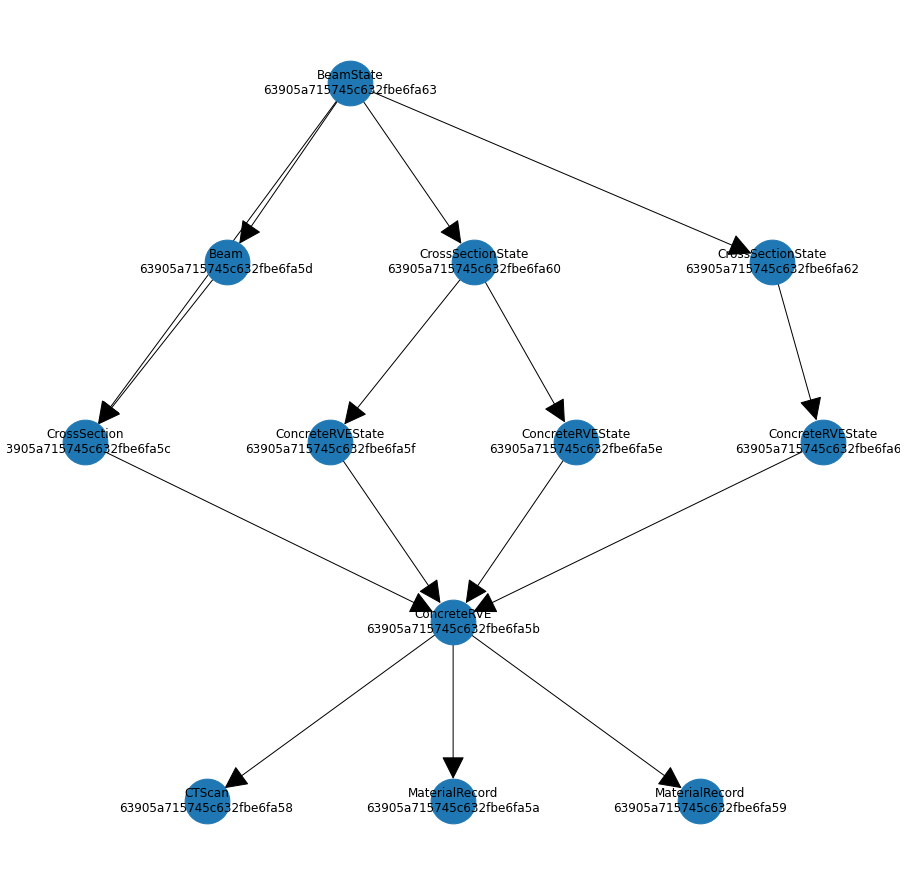
The data can be visualized via the graph endpoint which returns nodes and edges. This can be used to verify that referenced obejcts were inserted only once and are shared.
import networkx as nx
from networkx.drawing.nx_pydot import pydot_layout

import matplotlib.pyplot as plt
nodes,edges=get(f'{DB}/BeamState/{ID}/graph',debug=True,no_show=True)
G=nx.DiGraph()
G.add_nodes_from(nodes)
G.add_edges_from(edges)
rootNode=nodes[0]
fig,ax=plt.subplots(1,1,figsize=(16,16))
nx.draw(
    G,ax=ax,with_labels=True,
    node_size=2000,
    pos=pydot_layout(G,root=rootNode,prog='dot'),
    arrowsize=50,
)
2.2.1.7. Smart clone
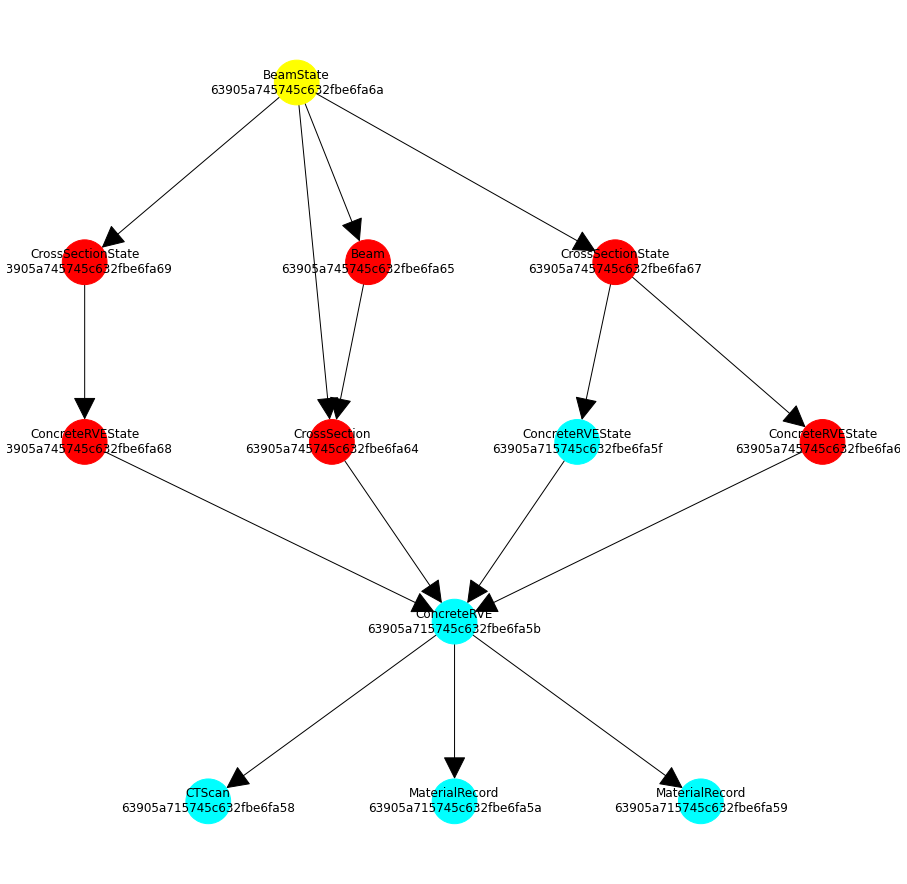
We use graph analysis to check which objects need to be deep-copied, given a list of write paths. The graph colors nodes based on whether they should be deep-copied (wiill be modified, or are on the path to modified object) or simply linked.
mods='cs.rvePositions csState[0].bendingMoment csState[0].eps_axial csState[0].rveStates[0].sigmaHom csState[1].rveStates[0].epsHom'
#mods='cs.rvePositions'
#mods=''
# get safe links including klass names (for graphing)
safe_debug=get(f'{DB}/BeamState/{ID}/safe-links',paths=mods,debug=True,no_show=True)
safe=get(f'{DB}/BeamState/{ID}/safe-links',paths=mods,no_show=True)

fig,ax=plt.subplots(1,1,figsize=(16,16))

# coloring function
def n_c(n):
    if n.endswith(ID): return 'yellow'
    if n in safe_debug: return 'cyan'
    return 'red'


nx.draw(
    G,ax=ax,with_labels=True,
    node_size=2000,
    pos=pydot_layout(G,root=rootNode,prog='dot'),
    arrowsize=50,
    node_color=[n_c(n) for n in G.nodes],

)
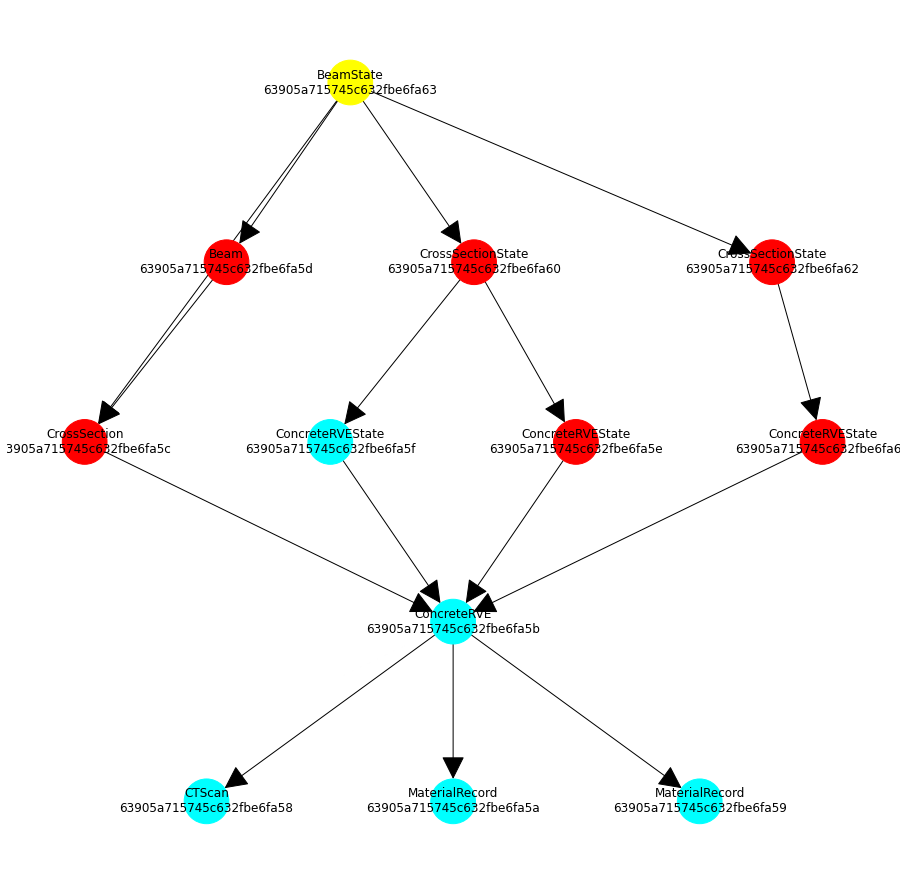
IDs of nodes which are safe can be passed to clone, which will only link them (instead of deep-copying). The following graph should be the same, but this time it is colored by database content after clone, by checking nodes which have upstream in their metadata (were deep-copied) and which were cloned (no upstream in _meta).
ID2=get(f'{DB}/BeamState/{ID}/clone',shallow=' '.join(safe))

nodes2,edges2=get(f'{DB}/BeamState/{ID2}/graph',debug=True,no_show=True)
G2=nx.DiGraph()
G2.add_nodes_from(nodes2)
G2.add_edges_from(edges2)
fig,ax=plt.subplots(1,1,figsize=(16,16))

# coloring function
def n_c(n):
    type,id=n.split('\n')
    if id==ID2: return 'yellow'
    # ask the DB whether the node has upstream (i.e. was cloned)
    nn=get(f'{DB}/{type}/{id}',max_level=1,no_show=True)
    if 'upstream' in nn['_meta']: return 'red'
    return 'cyan'

nx.draw(
    G2,ax=ax,with_labels=True,
    node_size=2000,
    pos=pydot_layout(G2,root=nodes2[0],prog='dot'),
    arrowsize=50,
    node_color=[n_c(n) for n in G2.nodes]
)
'63905a745745c632fbe6fa6a'